Understanding fire suppression systems such as heat detectors, alarms, and temperature-activated sprinkler heads is critical if you’re an individual or company performing heat treatments to eliminate bed bugs. These systems are meant to detect and prevent fire proliferation in a building. Heat treatments typically require a minimum of 120 degrees F, and commonly 140 degrees F is the target temperature of the operator. This creates a potential problem for activating fire suppression systems, which can be a very costly issue for everyone involved. Being able to identify these systems and their associated ratings can help drastically reduce the risk of unintended activations.
Heat Detectors
When performing a heat treatment for bed bugs, inspect the structure for heat detectors. Heat detectors look similar to a smoke detector, and some heat detectors are made in combination with a smoke detector. Rate-of-rise (ROR) heat detectors react to the sudden change or rise in ambient temperature from a normal baseline condition. Any sudden temperature increase that matches the predetermined alarm criteria will cause an alarm. This type of heat detector can react to a lower threshold condition than would be possible if the threshold were fixed. A typical alarm may sound when the rate of temperature rise exceeds 12° to 15°F (6.7° to 8.3°C) per minute.
Rate of Rise Detector pictured below

Fixed-Temperature heat detectors- This type of detector reacts when the ambient temperature reaches a fixed point. The most common fixed temperature point is 136.4°F (58°C). Recent technological developments have enabled the perfection of detectors that activate at a temperature of 117°F (47°C), providing increased time to escape.
Note: If a determination is made that these alarm devices exist in a structure, take preventative measures to ensure that a false alarm does not occur. A building or maintenance engineer, or alarm company will be able to provide further information to temporarily and safely interrupt these devices. Failure to do so can cause EMS and firefighters to use valuable resources to rush to your structure for a false alarm.
Sprinkler Systems
Sprinkler systems are commonplace in many office buildings, industrial spaces, newer multi-family dwellings, and some single-family homes. They are installed with a system of heads that either contain a bulb or fusible link. Once a certain temperature is reached, the bulb or link breaks, releasing a stream of water to prevent a fire from spreading.
Unfortunately, the most commonly used heads in dwellings/homes are rated for 135 degrees F or 155 degrees F. These are within the range of many heat treatment temperatures. Bear in mind that these are the activation temperatures. There are also ratings for “maximum ceiling temperature”, which are equally as important for consideration as the bulb or link temperature rating. This is a requirement of manufacturers for certification of products. Without going into extensive detail, the maximum ceiling temperature takes into account that a fire may be occurring in another room or area, and allow the system to react after prolonged exposure at a higher than usual temperature. While most heads will not react until the designated bulb temperature is reached, occasional accidental activations have occurred at the lower temperatures. This is rare but must be accounted for and addressed.
To prevent these activations, most operators/users either cover the heads with faucet covers, sprinkler covers, or they have the fire suppression company or building engineer drain the heads prior to treatment, then check the heads for damage prior to recharging the system.
Sprinkler Heads with Bulbs, in sequential temperature order . Click here to view an informational video in which we further discuss this topic.
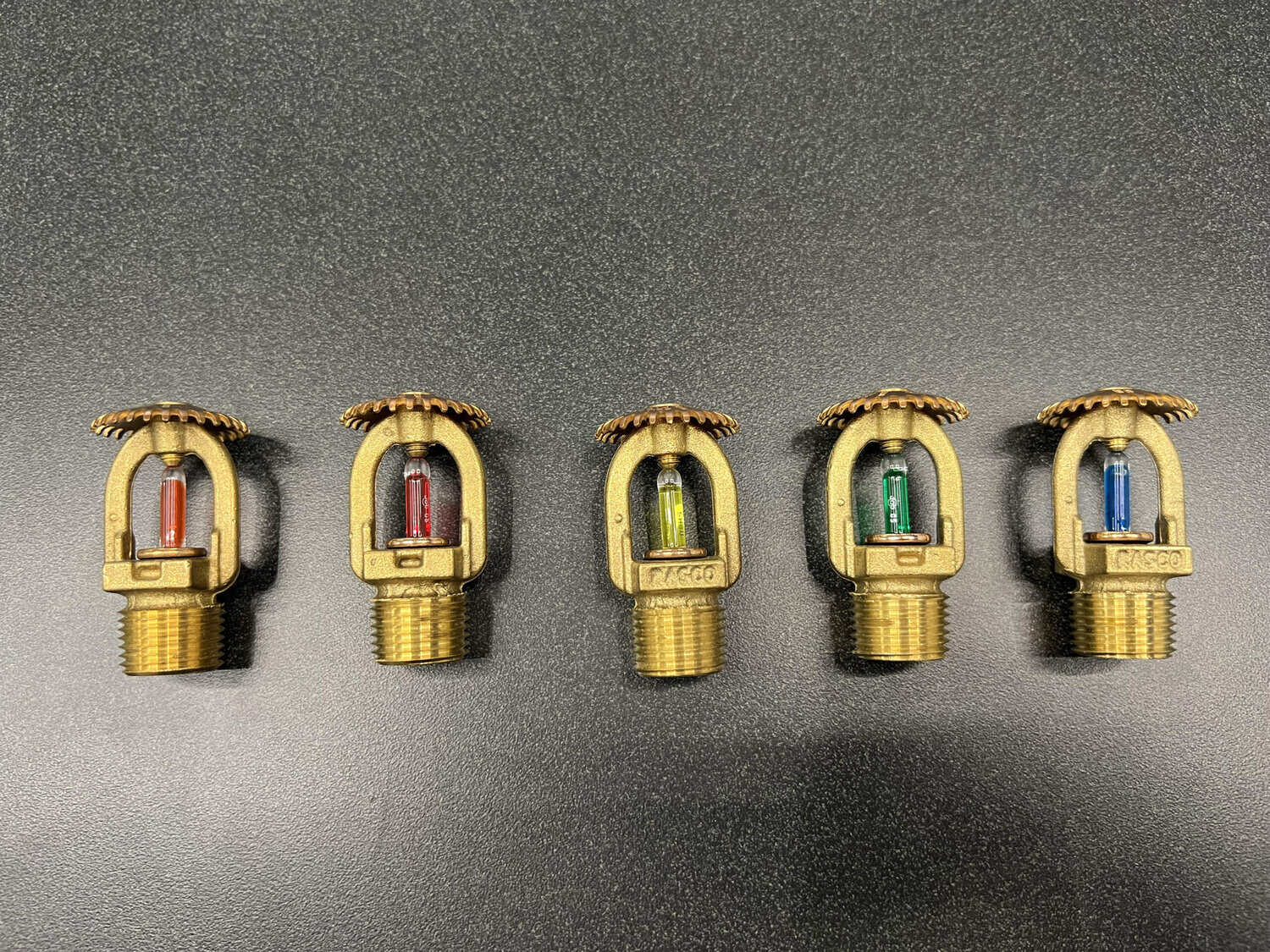
Below is a table from the (NFPA) National Fire Protection Association to identify sprinkler heads and their accompanying temperature thresholds.
| Maximum Ceiling Temperature | Temperature Rating | Temperature Classification | Color Code (with Fusible Link) | Glass Bulb Color |
| 100°F / 38°C | 135-170°F / 57-77°C | Ordinary | Uncolored or Black | Orange (135°F) or Red (155°F) |
| 150°F / 66°C | 175-225°F / 79-107°C | Intermediate | White | Yellow (175°F) or Green (200°F) |
| 225°F / 107°C | 250-300°F / 121-149°C | High | Blue | Blue |
| 300°F / 149°C | 325-375°F / 163-191°C | Extra High | Red | Purple |
| 375°F / 191°C | 400-475°F / 204-246°C | Very Extra High | Green | Black |
| 475°F / 246°C | 500-575°F / 260-302°C | Ultra High | Orange | Black |
| 625°F / 329°C | 650°F / 343°C | Ultra High | Orange | Black |
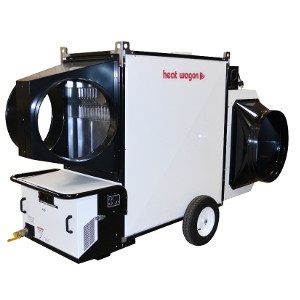
In closing, always review a structure prior to conducting a bed bug heat treatment and use a thermostatically controlled bed bug heater. If you can identify potential issues and work with building staff to protect systems, you can mitigate a cavalcade of issues that result from an accidental activation.